- All
- Product Name
- Product Keyword
- Product Model
- Product Summary
- Product Description
- Multi Field Search

 English
Views: 0 Author: Site Editor Publish Time: 2026-07-16 Origin: Site


Urban real estate constraints force developers to maximize every square foot of available land. Conventional parking infrastructure demands massive spatial footprints for drive aisles, ramps, and pedestrian clearances. High-density parking solutions address this spatial inefficiency, but they introduce significant operational risks. Moving multi-ton vehicles through tight vertical and horizontal spaces requires fault-tolerant, continuous operation. A mechanical failure or software crash in these environments results in trapped vehicles, severe liability, and immediate operational bottlenecks.
To mitigate these risks, developers rely on the Programmable Logic Controller (PLC) as the industrial-grade standard for managing an Automated Parking System. Unlike standard consumer electronics, PLCs offer deterministic logic processing designed specifically for harsh environments. This technical evaluation explores how PLCs manage complex input/output (I/O) tasks, ensure strict safety compliance, and dictate the long-term viability of high-density parking infrastructure.
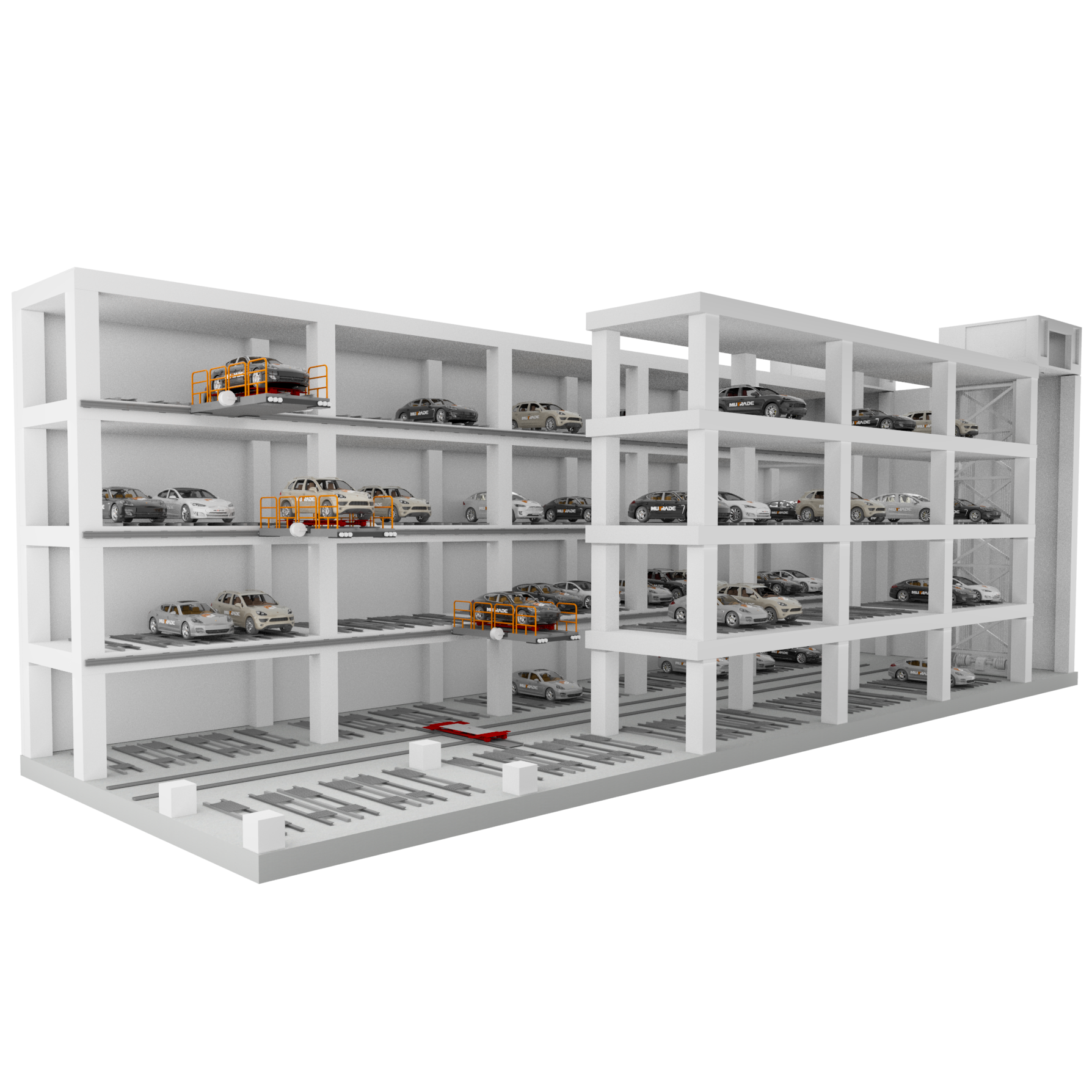
Industrial Reliability: PLCs replace fragile PC-based controls with ruggedized, deterministic logic processing, ensuring high uptime in harsh garage environments.
Precision Control: An automated parking system relies on PLCs to process thousands of inputs per second from sensors, RFID readers, and safety relays to execute flawless vehicle routing and retrieval.
Pre-Commissioning Validation: Utilizing 3D simulation software and dedicated PLC programming suites before physical deployment minimizes real-world collision risks and debugging downtime.
Scalability & Integration: Modern PLC architectures allow facility managers to scale I/O modules as parking capacity grows, integrating directly with Building Management Systems (BMS) via standard industrial protocols.
Risk Mitigation: Evaluating a PLC-driven system requires prioritizing hardware redundancy, fail-safe programming, and manual override capabilities to mitigate mechanical lock-ups.
Table of Contents
Operating high-density parking infrastructure requires strict adherence to specific success criteria. Facility managers expect zero vehicle damage, sub-three-minute retrieval times, and 99.9% system uptime. Achieving these metrics requires a control system capable of executing complex mechanical sequences without hesitation or error. Consumer-grade microcontrollers and standard PC-based systems lack the ruggedness and deterministic processing required for this level of reliability. When you have a 6,000-pound SUV sitting on a steel pallet suspended fifty feet in the air, you cannot rely on an operating system that might decide to run a background update.
In this context, a PLC serves as an industrial computer specifically engineered to control manufacturing processes and heavy machinery. Deterministic operation is the defining characteristic of a PLC. It guarantees response times within milliseconds. When moving multi-ton vehicles on automated lifts and shuttles, deterministic processing is non-negotiable. A delayed signal to a motor contactor or a missed sensor input can cause catastrophic mechanical collisions. The PLC executes its logic cycle in a highly predictable timeframe, ensuring that when a limit switch trips, the corresponding motor stops instantly.
The PLC functions as the central nervous system of the parking infrastructure. It continuously scans field inputs, executes the user-defined program, and updates outputs to mechanical actuators. This scan cycle repeats thousands of times per second. By utilizing standardized programming languages like ladder logic or structured text, the PLC translates physical sensor data into precise mechanical movements. We wire these systems to ensure every vehicle reaches its designated storage bay safely, without relying on human intervention.

Understanding the architecture of a PLC-driven parking facility requires analyzing how data flows through the system. The process relies on a continuous loop of sensing, processing, and actuating. Field technicians spend weeks mapping these I/O points before a single vehicle enters the facility.
Before any mechanical sequence initiates, the system must accurately map the physical environment. PLCs gather data through a vast network of input devices. Inductive loop detectors verify vehicle presence at the entry gate. Photoelectric sensors and laser scanners measure the exact dimensions of the vehicle, ensuring it does not exceed the height, width, or length constraints of the storage bay. Weight scales integrated into the transfer cabin prevent overloaded vehicles from damaging the lifting mechanisms.
The PLC converts these analog sensor signals into digital status flags. If a vehicle exceeds the weight limit or sits out of alignment, the PLC immediately halts the intake process. It triggers a user-facing alarm, requiring the driver to reposition the vehicle. This strict input validation prevents mechanical jams and protects the infrastructure from user error. In the field, we often install redundant sensors at the transfer cabin just to ensure a dirty lens does not cause a false positive.
Once the inputs are validated, the PLC's Central Processing Unit (CPU) takes over. The CPU scan cycle time determines how quickly the system reacts to changing conditions. High-capacity parking facilities require PLCs with substantial memory and processing power to track multiple vehicles simultaneously across various lifts and shuttle levels. You are essentially running a massive array of data blocks, where each block represents a physical parking bay and its current occupancy status.
Engineers program these controllers using IEC 61131-3 standard languages. Ladder Diagram (LD) provides a visual, relay-based logic structure that maintenance technicians can easily troubleshoot on the floor. Structured Text (ST) handles complex algorithms, such as dynamic space allocation. Dynamic allocation allows the system to store frequently used vehicles closer to the exit, optimizing retrieval times during peak hours. The modular nature of these programming languages ensures the code remains readable and highly maintainable for the life of the building.
After processing the logic, the PLC sends commands to the output devices. Safety is paramount during actuation. The PLC utilizes industrial-grade electromagnetic relays to isolate high-voltage power paths from the low-voltage control circuitry. This isolation protects the controller from electrical surges caused by large motors starting and stopping.
The PLC triggers motor contactors to move shuttles horizontally. It communicates with Variable Frequency Drives (VFDs) to control the vertical lifts. VFD integration provides smooth acceleration and deceleration, preventing vehicles from shifting on the pallets during transit. We parameterize the VFDs directly through the PLC network, allowing us to adjust ramp-up times based on the weight of the specific vehicle being lifted. Additionally, the PLC controls pneumatic and hydraulic relays to actuate entry gates and safety barriers.
System Component | Hardware Examples | Primary Function in Parking Automation |
|---|---|---|
Inputs | Photoelectric sensors, laser scanners, weight scales, RFID readers | Validate vehicle presence, dimensions, weight, and user authorization. |
Logic Processing | PLC CPU, Memory Modules, Safety Controllers | Execute ladder logic, manage dynamic space allocation, and enforce safety interlocks. |
Outputs | VFDs, motor contactors, hydraulic valves, indicator lights | Drive lift motors, actuate gates, control shuttle speeds, and signal users. |
Network | Industrial Ethernet switches, PROFINET cables | Facilitate high-speed communication between remote I/O racks and the main CPU. |
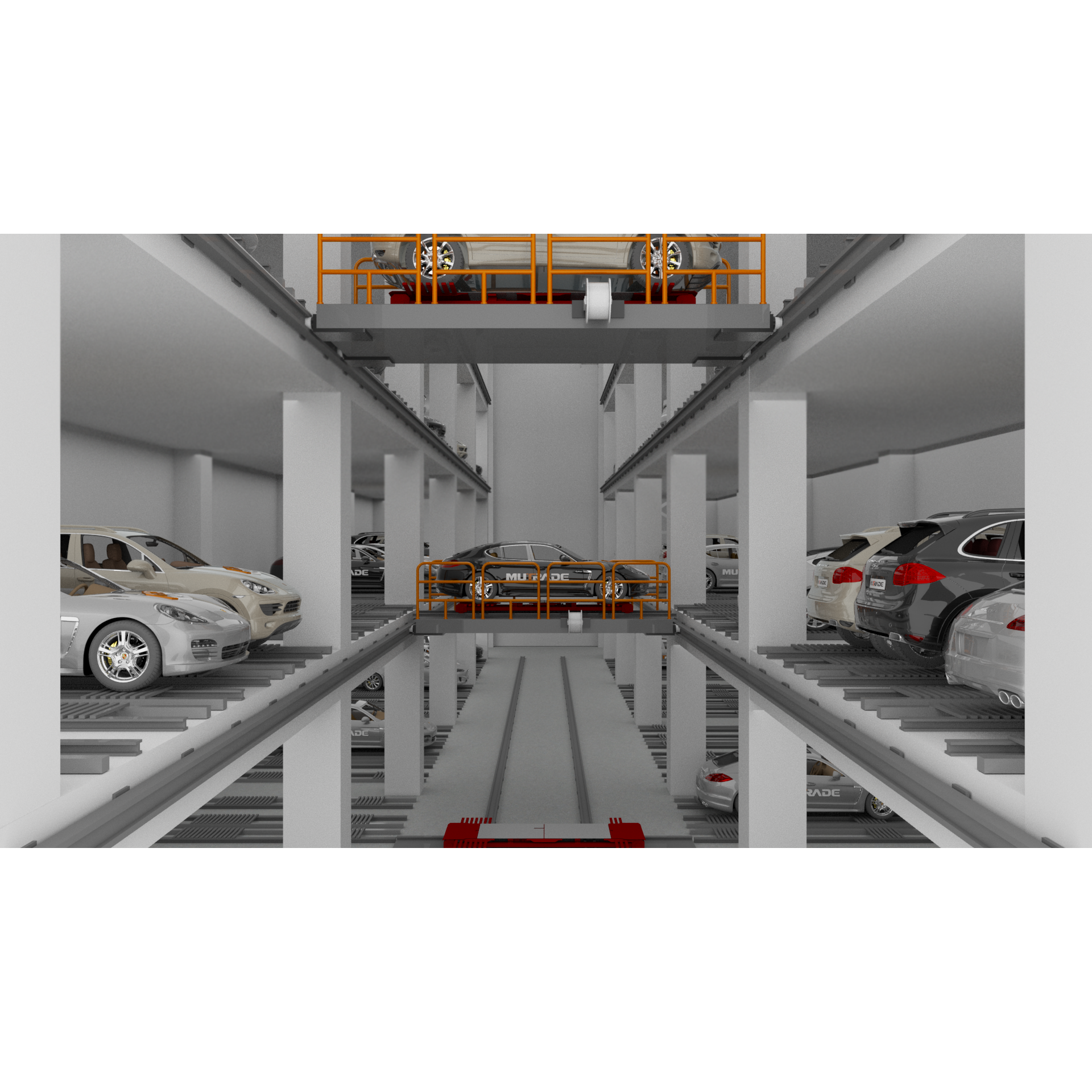
Selecting the right PLC hardware dictates the scalability and resilience of the entire facility. Facility managers must evaluate configurations based on processing power, I/O capacity, and network capabilities. You cannot simply buy an off-the-shelf controller and expect it to run a 500-bay facility.
The scale of the parking facility determines the I/O count requirements. A small boutique residential garage may require a few hundred I/O points. A massive automated facility with multiple lifts, dozens of transfer cabins, and hundreds of parking bays demands thousands of I/O points. Engineers must evaluate whether to deploy compact PLCs for smaller setups or modular PLCs for large-scale operations.
Modular PLCs utilize expansion racks, allowing facility managers to add input and output cards as the system grows. This scalability ensures the control architecture can adapt if the building undergoes future expansions or mechanical upgrades. We typically design the main control panel with at least 20% spare I/O capacity to accommodate future sensor additions or layout changes.
Mechanical lock-ups in high-density parking are unacceptable. To prevent single points of failure, premium systems utilize hot-standby PLC configurations. This setup involves redundant CPUs operating in parallel. The primary controller handles all active logic processing. The secondary controller continuously mirrors the primary's state over a dedicated fiber optic link.
If the primary controller experiences a hardware failure, the secondary CPU takes over seamlessly within milliseconds. This failover protocol ensures continuous operation, allowing lifts and shuttles to complete their current retrieval cycles without trapping vehicles mid-transit. We test this extensively during commissioning by physically pulling the power from the primary CPU while a lift is in motion.
Modern parking facilities do not operate in isolation. The PLC must communicate with supervisory control and data acquisition (SCADA) systems, payment kiosks, and the overarching Building Management System (BMS). This requires robust industrial communication protocols.
Protocols like PROFINET, EtherNet/IP, and Modbus TCP provide high-speed, reliable data transfer across the facility network. Integrating the PLC with the BMS allows facility managers to monitor energy consumption, track peak usage times, and receive automated maintenance alerts directly through their central dashboard. Running shielded Ethernet cables through concrete elevator shafts requires careful planning to avoid electromagnetic interference from the high-voltage motor lines.
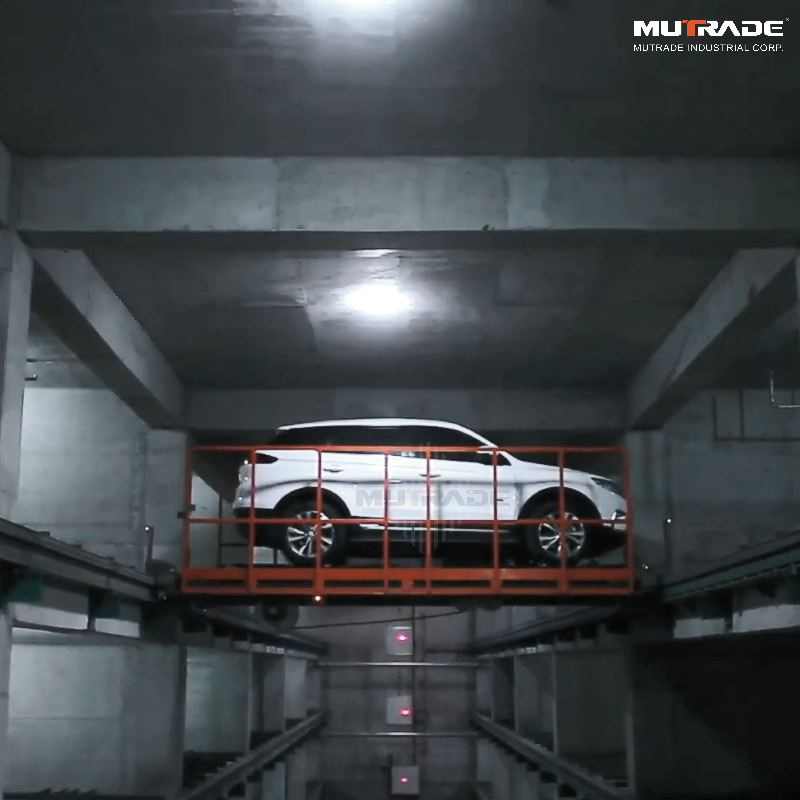
The PLC orchestrates every mechanical movement from the moment a driver arrives until the vehicle is safely returned. These workflows require precise sequencing and continuous safety monitoring. We break these down into distinct state machines within the PLC code.
The intake process follows a strict, non-bypassable sequence to ensure human safety and mechanical alignment. The PLC executes the following steps:
The driver scans an RFID card or takes a ticket at the entry kiosk.
The PLC verifies the credential against the database and opens the outer entry gate.
The driver pulls the vehicle onto the transfer pallet and exits the cabin.
The PLC initiates a comprehensive safety scan using light curtains and motion detectors to ensure no humans or pets remain inside the cabin.
The PLC actuates the inner gate and signals the transfer machinery to engage.
Only after confirming the area is completely clear does the PLC allow the lift to take control of the vehicle pallet.
Transporting the vehicle to its designated rack requires complex path calculations. The PLC determines the most efficient mechanical route for the automated guided vehicles (AGVs) or shuttle systems. It evaluates the current position of all moving components, checks for empty storage bays, and dispatches the shuttle.
The PLC continuously monitors the shuttle's position via laser positioning systems or absolute encoders. This closed-loop feedback ensures the shuttle aligns perfectly with the storage rack before transferring the vehicle pallet, preventing mechanical binding or dropping. If an encoder reports a position deviation of even a few millimeters, the PLC stops the shuttle and attempts an automatic realignment sequence.
During morning commutes or event departures, the system faces massive retrieval demands. The PLC manages these high-traffic periods through intelligent queue logic. It prioritizes movements to prevent mechanical bottlenecks, ensuring lifts do not sit idle waiting for shuttles.
If multiple users request their vehicles simultaneously, the PLC calculates the optimal retrieval sequence. It may command a lift to drop off an incoming vehicle on a lower level and immediately pick up an outgoing vehicle on the way back down. This load balancing maximizes mechanical throughput and keeps retrieval times within the acceptable one-to-three-minute window. We spend days tweaking these algorithms during the final commissioning phase to shave seconds off the cycle times.
Deploying a control system in a parking structure presents unique environmental and engineering challenges. Successful implementation requires rigorous software validation and robust hardware protection. A parking garage is not a clean room; it is a harsh industrial environment.
Unlike climate-controlled server rooms, parking structures expose electronics to severe environmental stress. Temperature fluctuations, high humidity, and exhaust particulates degrade standard circuit boards rapidly. PLCs designed for these environments feature conformal coating and operate within wide temperature ranges.
Furthermore, all control panels and remote I/O stations must utilize IP-rated enclosures. NEMA 4 or IP65 ratings protect the sensitive electronics from dust ingress and moisture, ensuring reliable operation regardless of seasonal weather changes. We always install anti-condensation heaters inside the main control cabinets to prevent moisture buildup during temperature drops.
Writing the logic for a high-density parking facility is a complex engineering task. Integrators rely on advanced PLC programming suites to develop robust control structures. These suites allow engineers to modularize the code, creating standardized function blocks for lifts, shuttles, and gates.
Before any physical steel is erected on-site, engineers utilize 3D automated parking simulation platforms. Virtual commissioning allows programmers to connect the actual PLC code to a 3D digital twin of the parking facility. They dry-run movements, verify safety interlocks, and test edge-case scenarios. This virtual testing prevents expensive physical collisions during on-site commissioning and significantly accelerates the project timeline. Finding a logic error in a simulation costs nothing; finding it when a lift crashes into a concrete wall is catastrophic.
Moving heavy machinery requires strict adherence to functional safety standards. The control architecture must include dedicated safety PLCs or hardwired safety relays carrying appropriate Safety Integrity Level (SIL) or Performance Level (PL) ratings.
These safety systems manage emergency stops (E-stops), light curtains, and maintenance access gates. If a technician opens a maintenance door, the safety PLC immediately cuts power to the motor contactors in that specific zone while allowing the rest of the facility to operate. Additionally, the PLC integrates with the building's fire alarm system, automatically halting mechanical movements and securing fire doors if smoke is detected.
Long-term reliability depends on effective maintenance tools. The PLC connects to Human-Machine Interfaces (HMIs) located at the control stations. These touchscreens provide maintenance personnel with real-time diagnostic data, sensor statuses, and detailed alarm logging.
When a fault occurs, the HMI displays the exact sensor or motor causing the issue, eliminating guesswork. Facility managers should ensure they partner with local system integrators who can provide ongoing support, perform logic updates, and source replacement parts for legacy PLC hardware. We program the HMIs to show a visual layout of the garage, turning a specific bay red if a sensor fails, so the technician knows exactly where to walk.
Investing in industrial-grade automation hardware fundamentally changes the spatial dynamics of a real estate development. The precision of PLC control allows developers to rethink how they allocate square footage.
Utilizing premium PLC hardware directly impacts the operational continuity of the facility. While consumer-grade microcontrollers might seem accessible, they lack the ruggedness required for continuous industrial use. Premium controllers reduce unexpected downtime, minimize the need for emergency maintenance calls, and extend the lifespan of the mechanical actuators by ensuring smooth, precise movements via VFD integration. The initial capital expenditure for a high-end PLC rack pays for itself by preventing a single multi-hour outage that traps fifty vehicles.
The primary value of a highly automated, PLC-driven facility lies in space optimization. Because the PLC maneuvers vehicles with millimeter precision, the system eliminates the need for human-navigated drive aisles, concrete ramps, and wide turning radii. Vehicles pack tightly into vertical racks.
This precision allows developers to reduce the overall parking footprint by up to 50% compared to conventional garages. The reclaimed square footage can then be repurposed for revenue-generating assets, such as additional residential units, retail spaces, or expanded commercial lobbies. The reliability of the control system directly enables this architectural efficiency.
A robust PLC control system is the foundation of a safe, efficient, and high-performance automated parking system. By combining deterministic control, intelligent vehicle routing, redundant hardware architecture, real-time monitoring, and comprehensive safety interlocks, developers can maximize system reliability, improve retrieval efficiency, and ensure stable long-term operation.
Working with an experienced parking system manufacturer is equally important for successful automation projects. Mutrade Industrial Corp. specializes in advanced automated parking systems, intelligent control technologies, and customized engineering solutions. With extensive project experience, innovative PLC integration capabilities, and strict quality management, we help developers, architects, and parking operators implement reliable, scalable, and high-efficiency parking systems for commercial, residential, and mixed-use developments.
Initiate a comprehensive site capacity audit to define your peak throughput requirements and spatial constraints.
Request detailed I/O architecture diagrams from potential system integrators to verify their approach to hardware redundancy and failover protocols.
Demand virtual commissioning and 3D simulation testing prior to physical installation to validate all logic and safety interlocks.
Ensure the selected PLC hardware utilizes open-standard industrial protocols to guarantee seamless BMS integration and long-term part availability.
A: The system relies on Uninterruptible Power Supplies (UPS) and backup generators. The UPS keeps the PLC and sensors powered, preventing data loss. The PLC's non-volatile memory retains the exact location of every vehicle. Once generator power engages, the PLC resumes operations without needing to remap the facility.
A: Yes, but it requires specific structural conditions. The facility must have adequate ceiling heights, sufficient load-bearing capacity for the steel racks, and a layout conducive to installing shuttle and lift infrastructure. A thorough structural engineering assessment is mandatory before retrofitting.
A: Systems utilize photoelectric sensors, ultrasonic sensors, and laser scanners to check vehicle dimensions and detect presence. Inductive loops detect vehicles at entry gates, while absolute encoders track the exact physical position of lifts and shuttles.
A: The PLC enforces strict logic interlocks. It uses light curtains and redundant safety sensors to monitor the transfer zones continuously. If a sensor detects an anomaly, such as a vehicle shifting or an obstruction in the path, the PLC immediately halts all mechanical movement.
A: Retrieval typically takes between 1 to 3 minutes. The exact timeframe depends on the system's architectural layout, the speed of the VFD-controlled lifts, and the PLC's queue logic for managing multiple simultaneous requests.
A: No. It is highly recommended to use open-standard, commercially available PLCs from established industrial automation brands. This avoids vendor lock-in, ensures you can find local programmers for maintenance, and guarantees long-term availability of replacement parts.
A: Software simulation allows engineers to connect the PLC logic to a digital twin of the facility. This validates the safety of the control code, prevents expensive physical collisions during testing, and significantly accelerates the on-site commissioning timeline.