- All
- Product Name
- Product Keyword
- Product Model
- Product Summary
- Product Description
- Multi Field Search

 English
Views: 0 Author: Site Editor Publish Time: 2026-03-23 Origin: Site


Automated parking systems are transforming the way we manage urban parking, making it faster, safer, and more efficient. From robotic lifts to puzzle and shuttle systems, there’s a solution for every space, traffic flow, and budget. Whether you’re managing a residential complex, office building, or commercial facility, understanding the types of automated parking systems can help you make the right choice. Let’s explore the options, key features, and advantages so you can optimise parking while saving time, space, and costs.
Automated parking systems come in many forms, and each one is designed to solve specific challenges like limited space, high traffic, or irregular building layouts. Some systems focus on speed, while others prioritise density or flexibility. Understanding how each type works will help you choose the right solution for your project.
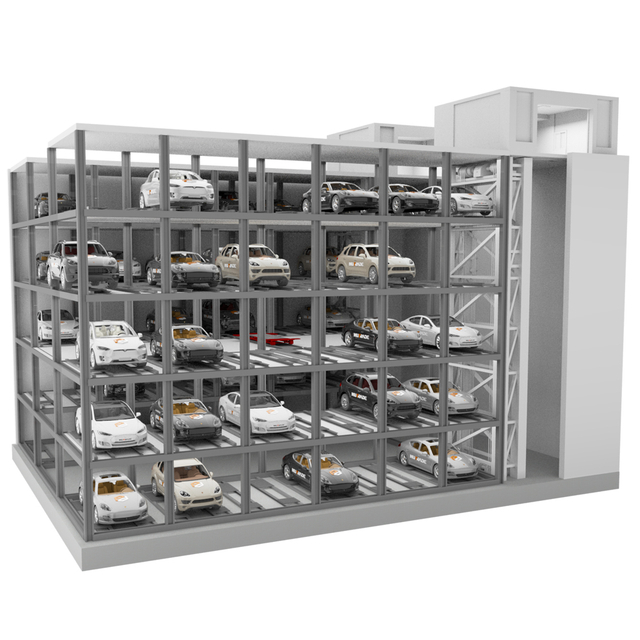
Robotic automated parking systems represent the highest level of automation. Drivers simply leave their vehicles in a designated area, and the system takes full control. It uses robotic arms, lifts, or shuttles to move the vehicle to a parking space without human involvement.
Vertical robotic parking systems move vehicles upward into stacked storage levels
Horizontal robotic parking systems transport vehicles across a flat layout
| Category | Details |
|---|---|
| Key Features | Fully automated process from drop-off to retrieval |
| High precision handling reduces risk of damage | |
| No need for internal driving lanes or ramps | |
| Advantages | Maximises space utilisation |
| Offers a seamless, premium user experience | |
| Disadvantages | High upfront investment |
| Requires skilled maintenance and technical support |
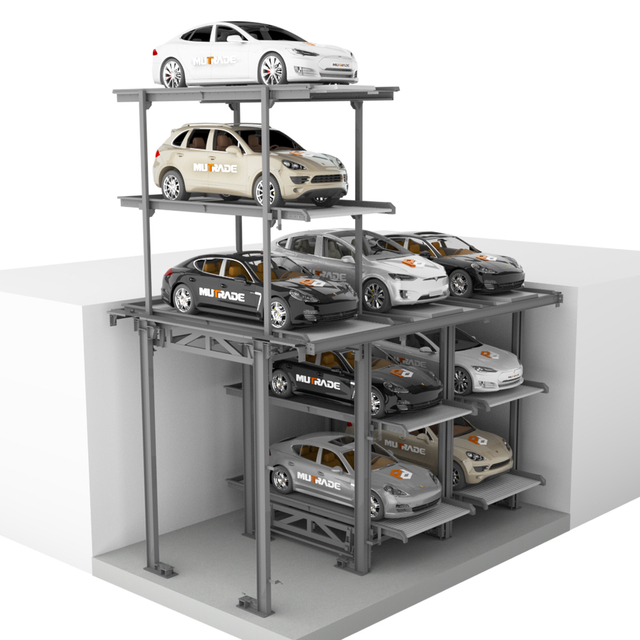
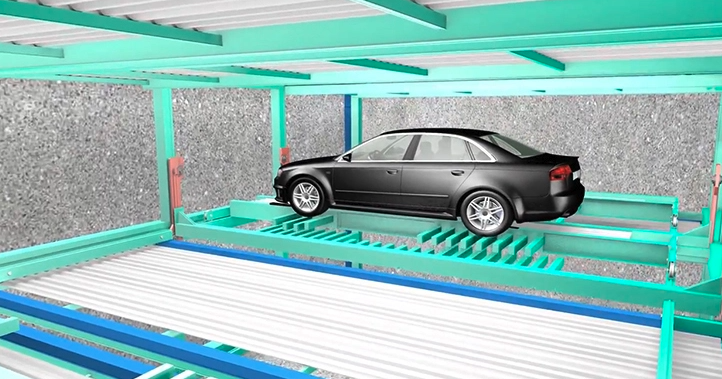
Puzzle parking systems use a grid-based layout. Vehicles are arranged on platforms that shift horizontally or vertically to create space, much like solving a puzzle. These systems are common in residential buildings and office complexes.
Simple systems with basic up-and-down or side-to-side movement
Multi-layer systems combining both directions for higher density
| Category | Details |
|---|---|
| Key Features | Combine vertical and horizontal motion for efficient space usage |
| Simpler system compared to fully robotic solutions | |
| Suitable for medium-scale projects | |
| Advantages | Cost-effective compared to advanced robotic systems |
| Good balance between automation and affordability | |
| Disadvantages | Retrieval time may increase in complex system layouts |
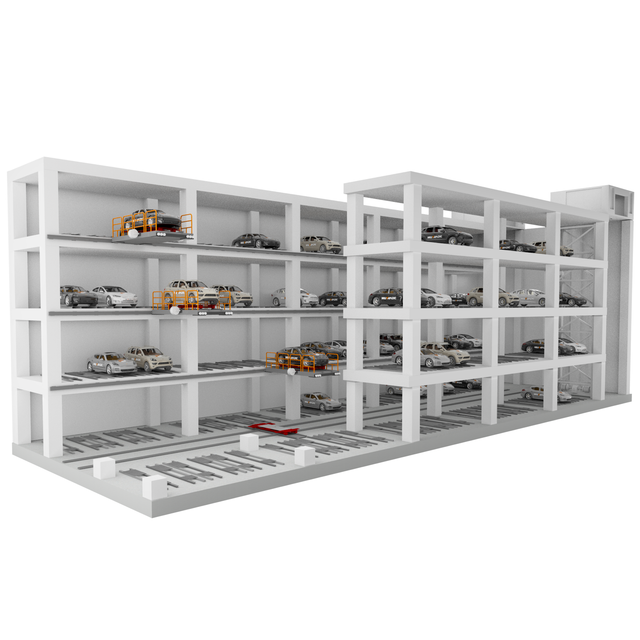
Shuttle parking systems rely on rail-guided vehicles that move cars across storage racks. They are commonly used in large parking facilities where handling a high number of vehicles quickly is important. Shuttle parking systems operate by first moving a vehicle vertically using a lift to reach the required level. Once at the correct level, a shuttle transports the car horizontally along rails to its designated parking spot.
These systems are designed for large-scale operations and provide high throughput, allowing vehicles to be parked and retrieved quickly. A continuous power supply ensures stable and reliable performance. Shuttle systems are highly efficient for facilities with large parking capacities and can be scaled to accommodate future growth. They require significant infrastructure and need extra space for the rail system and shuttle movement, which can increase installation costs and design complexity.
In conveyor-based parking systems, vehicles are first placed on specially designed pallets. These pallets are then transported through a network of automated conveyors that can move cars in multiple directions, including horizontally and vertically. This multi-directional movement allows the system to adapt to irregular or unconventional building layouts, making it highly flexible for complex spaces. Conveyor systems are often used in properties where optimising every square foot is critical, and they can accommodate varying vehicle sizes efficiently.
Advantages:
Flexible layout design: The system can adapt to irregular floor plans, curves, and odd-shaped spaces, which is ideal for buildings with architectural constraints.
High storage density: By combining horizontal and vertical movements, these systems maximise the number of vehicles that can be parked within a limited footprint, making them highly space-efficient.
Disadvantages:
Complex arrangements affect speed: The more intricate the conveyor network, the longer it may take to park or retrieve a vehicle, potentially slowing down operation during peak hours.
Maintenance and technical demands: Conveyor belts, motors, and sensors require regular maintenance and skilled technicians to ensure smooth operation, adding to operational costs.
Crane-based systems use a single machine to perform both vertical lifting and horizontal movement. It works similarly to automated warehouse cranes.
| Category | Details |
|---|---|
| Key Features | Combines vertical and horizontal movements into a single system |
| Centralised control simplifies operation | |
| Suitable for mid-sized parking structures | |
| Advantages | Fewer moving parts compared to multi-device systems |
| Maintenance can be easier in some cases | |
| Disadvantages | Slower operation when handling multiple vehicles |
AGV (Autonomous Guided Vehicle) parking systems rely on battery-powered robotic vehicles to transport cars within the facility. Unlike rail-based systems, these vehicles move freely across the floor without the need for fixed tracks or paths, giving the system a high degree of layout flexibility. They navigate using advanced sensors and AI technology, allowing precise movement and obstacle detection. Additionally, AGV systems are easy to reconfigure when layouts or parking needs change, making them ideal for adaptable or modern smart parking facilities.
Advantages:
Highly flexible and adaptable
Suitable for modern smart parking facilities
Disadvantages:
Limited capacity compared to rail-based systems
Performance depends on battery charging cycles
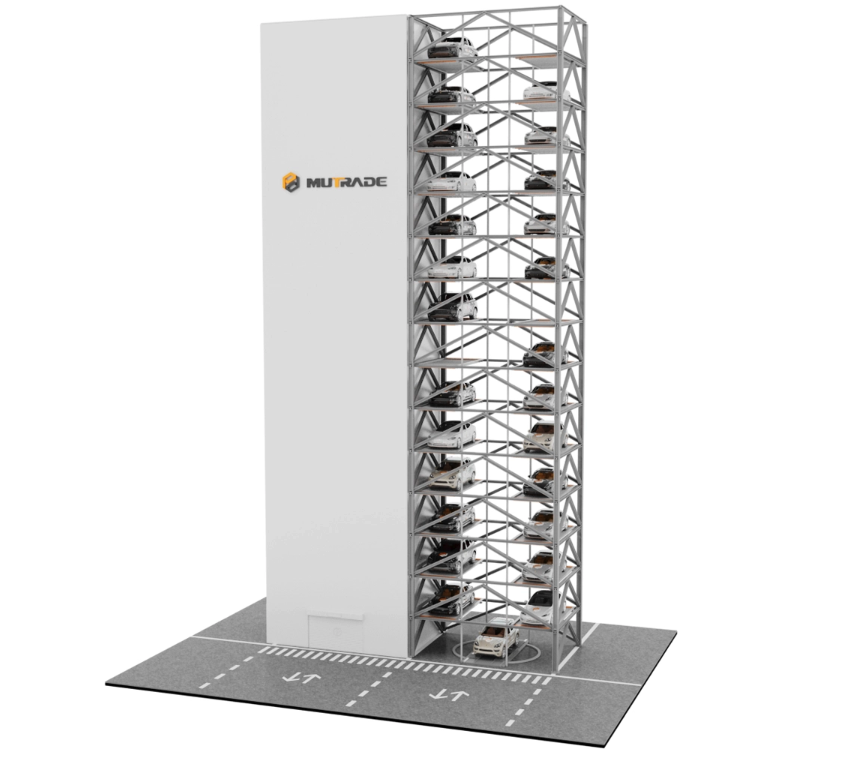
Lift-slide systems combine vertical lifts and horizontal sliding platforms. They are often used in tower-style parking structures where space is limited.
Tower systems stack vehicles vertically in tall structures
Compartment systems organise vehicles into modular units
These systems are ideal for urban environments. They maximise vertical space while keeping the footprint small.
Advantages:
High parking density
Efficient for tight city locations
Disadvantages:
Slower movement due to reliance on lifts
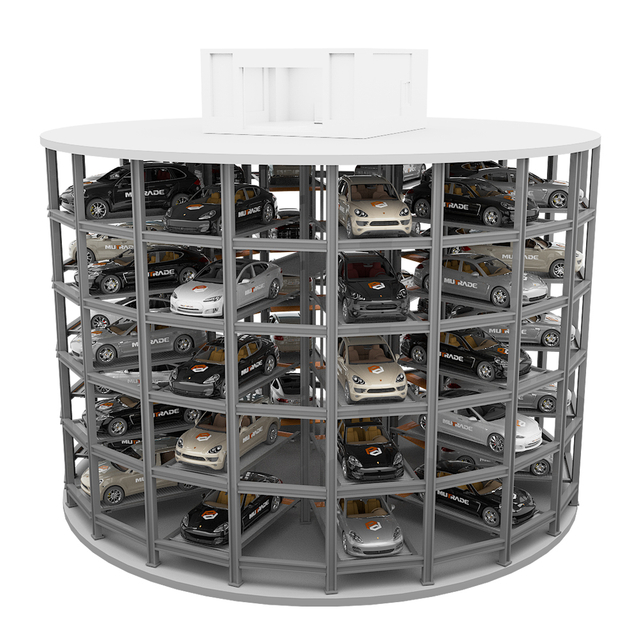
Rotary automated parking systems function like a vertical carousel. Vehicles are placed on rotating platforms that turn in a circular motion to move cars into storage positions and bring them back for retrieval. The system is compact and mechanically simple, which makes it easy to install and operate. Its small footprint makes it particularly suitable for properties with limited space or small plots where traditional parking would be impractical.
Advantages:
Cost-effective solution: Rotary automated parking systems require less construction and mechanical complexity, making them an affordable option for small urban developments or private properties.
Works well in very limited spaces: The vertical carousel design maximises space utilisation, allowing efficient parking where land availability is scarce.
Disadvantages:
Limited capacity: Due to the circular platform design, the number of vehicles that can be stored is lower than multi-level or shuttle-based automated parking systems.
Not suitable for high-traffic areas: Rotary systems can be slower during peak times, so they are better suited for properties with moderate parking demand rather than busy commercial centers.
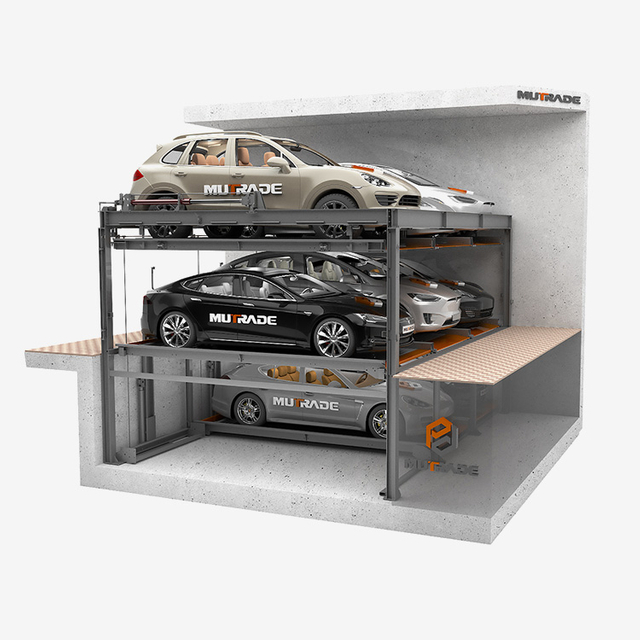
Underground systems place the entire parking operation below ground level. Vehicles are automatically transported into underground storage areas.
| Category | Details |
|---|---|
| Key Features | Entire operation placed below ground level |
| Invisible from the surface | |
| Maximises land usage and reduces surface congestion | |
| Advantages | Clean and modern appearance |
| Ideal for premium urban developments | |
| Disadvantages | High construction and engineering costs |
| Longer installation and setup time |
Choosing the right automated parking system (APS) is more than picking the latest technology. Several practical factors determine how well a system will perform for your property, your budget, and your users. Let’s break down the key considerations.
The size and shape of your land play a huge role in selecting a system. Narrow, irregular plots may benefit from conveyor or puzzle parking systems, while larger, rectangular areas are ideal for shuttle-based systems. Consider vertical space too—tall buildings allow tower or lift-slide systems.
Compact spaces: Puzzle, rotary, or underground APS
Large open areas: Shuttle or conveyor systems
Irregular layouts: AGV systems adapt easily
How many vehicles do you need to accommodate daily? Small facilities might manage with rotary or simple lift-slide systems. Large-scale commercial properties require high-capacity shuttles or multi-level tower systems. Matching capacity prevents bottlenecks and ensures smooth operation.
Small-scale: Up to 50–100 vehicles, simpler APS work best
Medium-scale: 100–300 vehicles, puzzle or AGV systems balance space and cost
Large-scale: 300+ vehicles, shuttle or fully robotic systems provide speed and efficiency
Automated parking systems vary greatly in cost. Some require high upfront investment but save on land and staffing costs. Others are cheaper initially but may need more space or incur higher operational expenses. Always consider long-term ROI when evaluating options.
| Cost Factor | Low-Cost Options | High-End Options |
|---|---|---|
| Installation | Rotary, simple puzzle | Robotic, underground |
| Land Efficiency | Moderate | Maximum vertical utilisation |
| Operational Savings | Low to moderate | High over time |
APS need to handle your peak hours efficiently. High turnover areas, like office complexes or shopping centers, require systems with fast retrieval times and multiple access points. Less busy locations can manage with slower, smaller systems.
Peak hours: Shuttle or fully robotic systems
Moderate usage: Puzzle or lift-slide systems
Low turnover: Rotary or AGV systems suffice
Your parking system can double as a security layer. High-security properties may need ANPR integration, controlled access, or surveillance-ready APS. Standard facilities may rely on simpler access controls without AI or camera systems.
High-security: Robotic or tower systems with controlled access
Standard: Rotary, puzzle, or AGV systems without additional sensors
Automated systems are mechanical and software-driven, so reliable maintenance is crucial. Check if trained technicians are available locally. Some systems require frequent servicing, especially complex shuttles or fully robotic setups.
Simple systems: Easier maintenance, fewer failures
Advanced systems: Require skilled personnel and periodic calibration
Support network: Local availability improves uptime and reduces operational risk
Choosing the right automated parking system doesn’t have to be overwhelming. With options ranging from compact rotary solutions to advanced robotic and AGV systems, you can match technology to your facility’s space, capacity, and traffic needs. Thinking about security, maintenance, and long-term ROI ensures a smoother operation and happier users. If you’re looking for reliable solutions, Qingdao Mutrade Co., Ltd. offers tailored automated parking systems to help maximise efficiency and make parking smarter, easier, and hassle-free.
Puzzle parking systems arrange vehicles on movable platforms that shift horizontally and vertically, allowing multiple cars to fit into a compact grid-like layout.
Shuttle systems move vehicles along fixed rails with vertical lifts for large-scale operations, while conveyor or pallet systems use multi-directional movement and pallets for irregular layouts.
They provide high parking density by combining vertical and horizontal movement, making them suitable for urban areas with limited footprints.
Rotary systems are best for low to moderate traffic as they have a limited capacity and slower retrieval compared to multi-level or shuttle-based APS.
Underground APS maximise land use, keep the surface area clear, and create a clean, modern appearance, but they involve higher construction costs and longer installation times.