- All
- Product Name
- Product Keyword
- Product Model
- Product Summary
- Product Description
- Multi Field Search

 English
Views: 0 Author: Site Editor Publish Time: 2026-07-16 Origin: Site


Vehicle transport systems carry incredibly high stakes in modern infrastructure. Drive system failures in parking equipment result in trapped assets, severe facility bottlenecks, and significant liability risks. Standard material handling motors simply fall short when faced with the specific demands of vehicle transport. Specifying an underpowered or mismatched drive system leads to premature component wear, excessive energy consumption, and an inability to handle peak-hour duty cycles.
Selecting the optimal motor and drive system requires a rigorous evaluation of load profiles, facility infrastructure, environmental conditions, and long-term maintenance accessibility. Engineers and facility planners must look beyond basic lifting capacities. You must analyze the dynamic forces at play when moving multi-ton vehicles. A properly specified drive architecture ensures seamless operation, mitigates safety risks, and maintains high throughput during the busiest hours of the day.
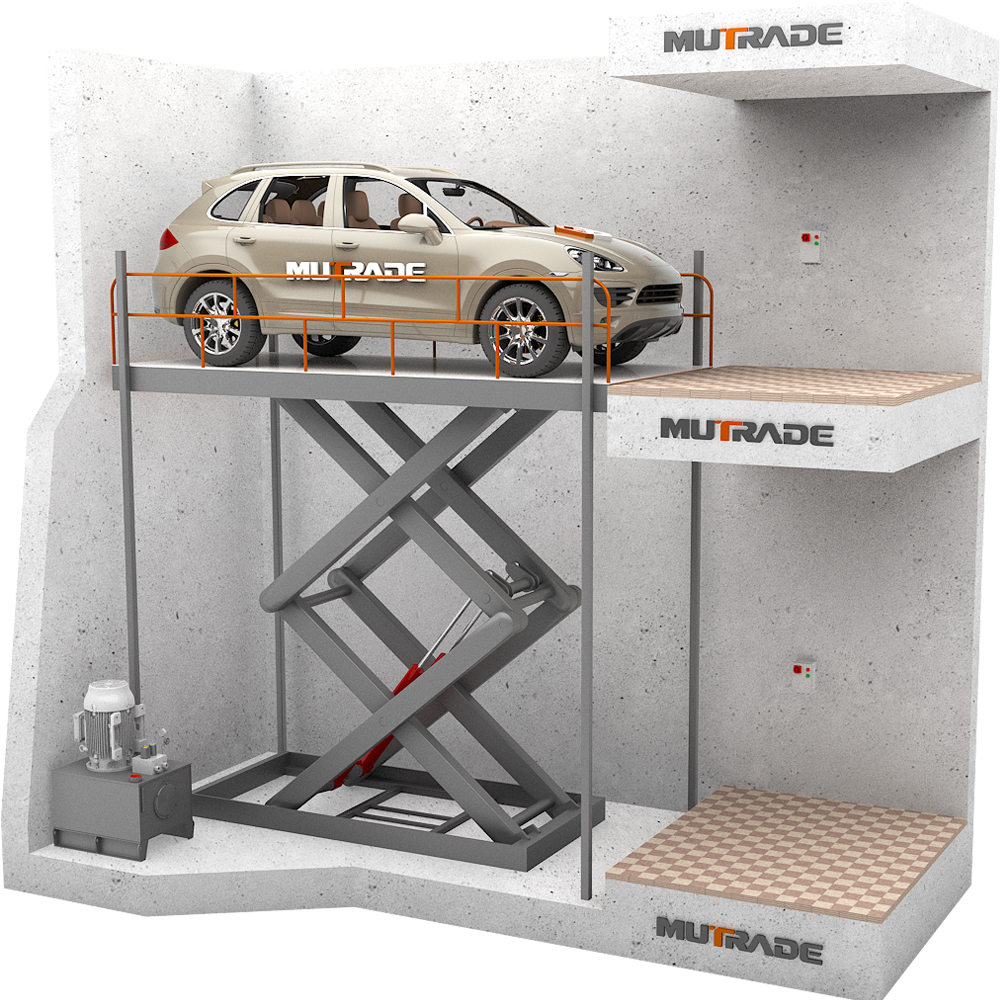
Drive Architecture Dictates Application: Hydraulic drives offer cost-effective, high-force solutions for low-rise parking lifts, while Variable Frequency Drive (VFD) electric traction systems are mandatory for high-throughput, multi-level car elevators.
Duty Cycle Outweighs Static Capacity: Sizing a motor based solely on maximum vehicle weight is a critical error; peak operational frequency (duty cycle) dictates thermal management and motor lifespan.
Infrastructure Constraints Limit Options: Available facility voltage, phase power, and spatial limitations (e.g., the need for Machine Room-Less configurations) will immediately eliminate certain drive categories.
Engineering for maximum Gross Vehicle Weight Ratings (GVWR) is the foundational step in motor specification. The rapid adoption of Electric Vehicles (EVs) has drastically increased average vehicle weights. Battery packs add significant mass, requiring drive systems to handle heavier baseline loads. You must calculate these static weights accurately to ensure the lifting mechanism operates within safe structural limits. A standard sedan might weigh 3,500 pounds, but a modern electric SUV easily pushes past 6,500 pounds. If you size the motor for legacy internal combustion vehicles, the system will stall or overheat when loaded with modern EVs.
Dynamic load shifts present an even greater challenge. When a vehicle enters or exits a Car Elevator, the suspension compresses and rebounds. This movement transfers dynamic forces directly into the platform and drive system. The motor must absorb these sudden torque variations without stalling or causing platform deflection. Properly sizing the drive to handle dynamic ingress and egress forces prevents long-term mechanical degradation. You have to account for the impact load of a vehicle rolling over the threshold, which momentarily spikes the force exerted on the lifting cables or hydraulic cylinders.
Determining the required horsepower (HP) and torque profiles requires precise mathematical modeling. You must evaluate both continuous torque for steady lifting and peak torque for overcoming initial inertia. Lifting heavy vehicles demands a motor capable of delivering high starting torque without drawing excessive inrush current. This balance protects the local electrical grid from brownouts.
Determine the maximum GVWR of the heaviest expected vehicle.
Add the dead weight of the lifting platform and any structural carriage components.
Define the required vertical travel speed in feet per minute (FPM).
Calculate the total mechanical load and factor in the mechanical efficiency rating of the gearboxes, sheaves, or hydraulic pumps.
Select a motor with a continuous horsepower rating that exceeds the calculated load by a minimum 20% safety margin.
Verify the motor's peak torque capability can overcome the static inertia of the fully loaded platform from a dead stop.
The mathematical relationship between lifting speed, total load weight, and mechanical efficiency dictates the final motor size. Faster lifting speeds require exponentially more horsepower for the same vehicle weight. Inefficiencies in power transmission mean the motor must produce more raw output to achieve the desired platform speed. A gearless traction system might operate at 90% efficiency, while a geared hydraulic setup might only hit 70%, drastically changing your motor requirements.
Duty cycle classifications define how often parking equipment operates within a given timeframe. Residential low-use systems may only cycle a few times per day. Commercial high-volume facilities might experience continuous operation during morning and evening rush hours. You must classify the expected usage accurately to select a motor built for that specific operational tempo.
Thermal limits become the primary failure point during continuous peak-hour operation. Motors generate heat under load. If the duty cycle exceeds the motor's ability to dissipate that heat, the internal insulation will degrade rapidly. High-volume systems require dedicated cooling mechanisms, such as forced-air ventilation or advanced heat sinks, to maintain safe operating temperatures during heavy use. When a motor bakes in a poorly ventilated hoistway during a two-hour morning rush, the winding insulation breaks down, leading to a catastrophic short circuit.
Rapid retrieval times keep traffic flowing in busy facilities. High-speed operation complicates the leveling process at landing zones. The drive system must balance swift vertical movement with the ability to decelerate smoothly. Abrupt stops cause vehicle shifting and passenger discomfort. You cannot simply throw a massive motor at the problem; you need sophisticated control logic to manage the deceleration curve.
Millimeter-precise leveling is an absolute requirement to prevent vehicle damage. If the platform stops unevenly with the building floor, tires and suspensions can sustain damage during exit. Advanced drive systems use closed-loop feedback to monitor platform position continuously. This allows the motor to adjust its speed dynamically, ensuring a perfectly flush landing every single time. Encoders mounted on the motor shaft feed real-time RPM data back to the controller, allowing for micro-adjustments as the platform approaches the floor.

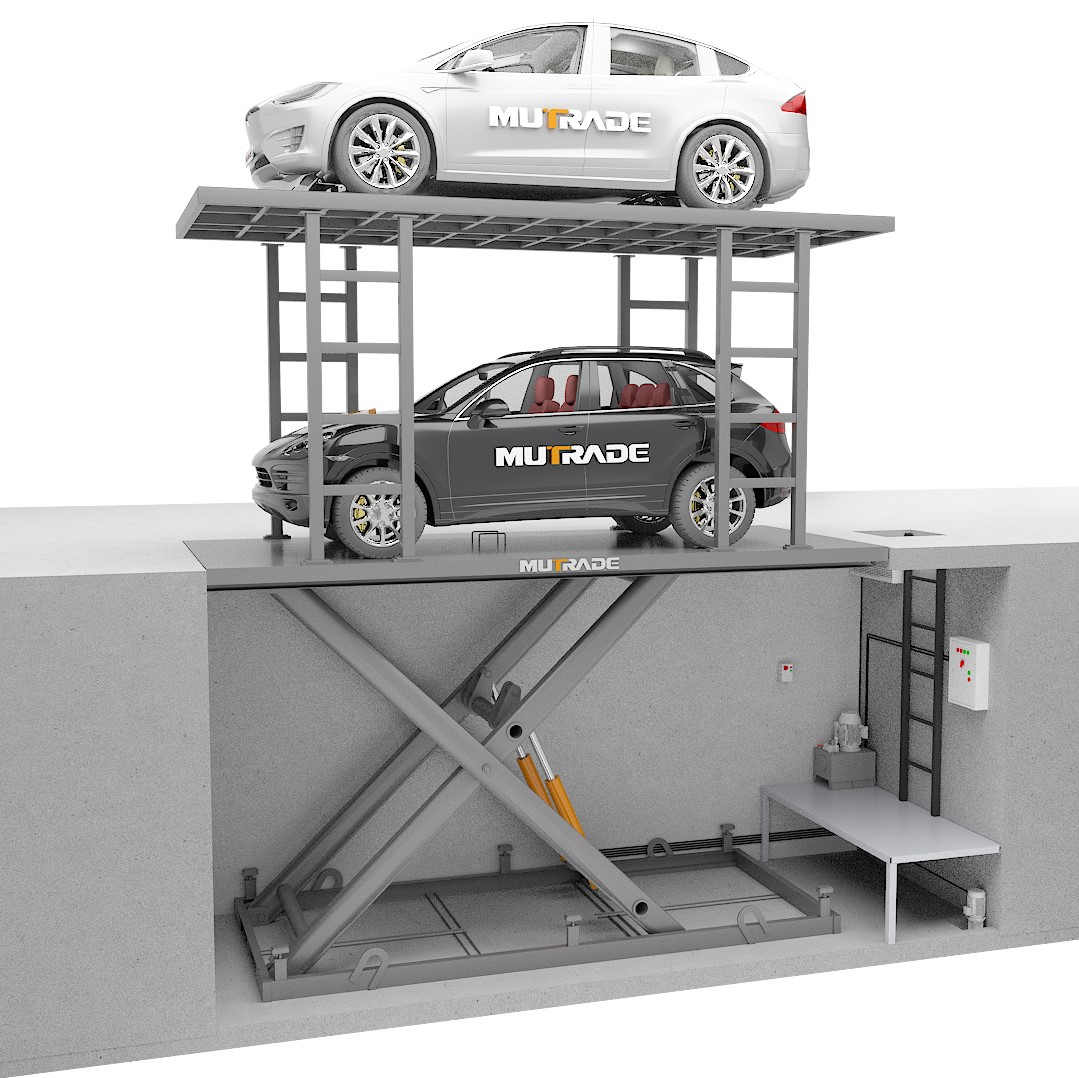
Hydraulic systems utilize submersible or external electric motors to drive high-pressure hydraulic pumps. These pumps force fluid into heavy-duty cylinders, which physically push the lifting platform upward. The mechanism is straightforward, relying on fluid dynamics to generate massive lifting force with relatively compact motor units. You will typically see these installed with the pump and motor sitting inside a steel reservoir tank, which helps dampen the noise.
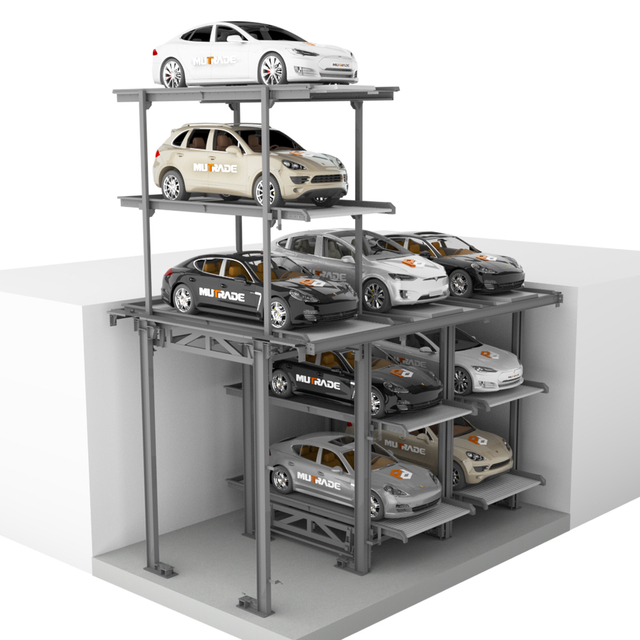
This architecture is the best fit for 2-post or 4-post lifts, subterranean stackers, and low-travel applications. The inherent design excels at moving heavy loads over short vertical distances. They provide exceptional lifting force and generally require a lower initial capital investment compared to complex traction systems. When you need to bury a lift in a shallow pit to hide vehicles underground, hydraulics are usually the go-to solution.
Hydraulic drives have distinct limitations. They operate at slower speeds, making them unsuitable for high-rise applications. There is always a risk of fluid leaks, which requires strict environmental containment protocols. Hydraulic fluid viscosity changes with temperature, making these systems sensitive to extreme weather conditions. If the oil gets too cold, the lift moves sluggishly; if it gets too hot, the fluid thins out and you lose lifting capacity.
Electric traction systems rely on geared or gearless AC motors. These motors are paired with Variable Frequency Drives (VFDs) to control rotational speed and torque precisely. Steel cables or synthetic belts connect the motor sheaves to the lifting platform and counterweights, creating a highly efficient mechanical loop. The counterweight does most of the heavy lifting, meaning the motor only has to move the unbalanced load.
These systems are the mandatory choice for multi-story vehicle transport and automated high-density parking facilities. A VFD-driven Parking Lift can travel hundreds of feet smoothly. They offer superior energy efficiency because the counterweight balances the load. You will see these in high-rise luxury condos where residents park their cars directly in their apartments.
The primary advantages include precise speed control, rapid acceleration, and an exceptionally high duty-cycle tolerance. They can run continuously without the thermal degradation seen in hydraulic systems. The trade-offs involve a more complex installation process and a larger structural footprint for the hoistway and mechanical components. You have to pour a deeper pit and build a stronger overhead structure to support the hanging weight of the car and counterweight.
Automated systems utilize compact, wheel-rim or in-wheel hub integrated electric motors. These localized propulsion drives allow robotic shuttles to move underneath vehicles, lift them, and transport them to storage racks. The motors are highly specialized, focusing on horizontal maneuverability and precise positioning rather than vertical lifting. They operate on flat concrete slabs, sliding under the vehicle's chassis to pick it up by the tires.
AGV propulsion is the best fit for robotic pallet systems and automated parking facility shuttles. These low-voltage DC brushless motors are configured for onboard battery technologies. They demand specialized charging interfaces and sophisticated energy management systems to ensure the shuttles remain operational throughout the day. The facility must have dedicated charging bays where the robots can dock and juice up during off-peak hours.
This architecture offers ultimate space efficiency. By removing the driver and utilizing omnidirectional AGVs, facilities can pack vehicles tightly together. These systems require perfectly level floors with strict tolerance requirements. They also introduce dependencies on battery health and charging infrastructure uptime. If a robot dies in the middle of an aisle, it creates a massive bottleneck that requires manual intervention to clear.
Drive Architecture | Primary Mechanism | Best Application | Key Advantage | Main Limitation |
|---|---|---|---|---|
Hydraulic | Pump and fluid cylinders | Low-rise, stackers | High lifting force | Slow speeds, fluid leaks |
Electric Traction (VFD) | AC motor with counterweight | Multi-story elevators | High speed, continuous duty | Complex installation |
AGV Propulsion | DC brushless hub motors | Robotic automated parking | Maximum space efficiency | Strict floor tolerances |
The available facility power dictates your motor options immediately. You must assess whether the building provides 208V, 230V, or 460V 3-phase power. Heavy-duty vehicle lifts require robust 3-phase infrastructure to operate efficiently. Attempting to run large motors on inadequate power supplies leads to voltage drops, sluggish performance, and eventual equipment failure. Pulling heavy gauge wire from the main breaker panel to the elevator machine room is a major construction expense that must be factored into the initial design.
Managing massive inrush current is critical when starting heavy loads. Across-the-line motor starters draw immense amperage, which can cause local grid voltage sags. Soft starters mitigate this by ramping up the voltage gradually. VFDs offer the ultimate control, managing the exact frequency and voltage to eliminate current spikes entirely during the starting cycle. A VFD allows you to dial in the exact acceleration curve, preventing the lights in the building from dimming every time the elevator starts moving.
Regenerative drives offer significant energy recovery in high-traffic facilities. When a heavy vehicle descends, the traction motor acts as a generator. Regenerative VFDs capture this kinetic energy and feed it back into the building's electrical grid. This technology drastically reduces the net energy consumption of busy automated parking structures. Instead of burning off that excess energy as heat through a braking resistor, you push it back into the building to power lighting or HVAC systems.
Outdoor parking equipment faces severe environmental challenges. Rain, snow, and corrosive road salts attack electrical components relentlessly. You must analyze the Ingress Protection (IP) and NEMA enclosure ratings required for your specific climate. A NEMA 4X stainless steel enclosure is mandatory for coastal or freezing environments, whereas a NEMA 1 enclosure suffices for climate-controlled indoor setups. If you install a standard indoor motor on an exterior lift exposed to ocean air, the salt will eat through the casing in less than a year.
NEMA 1: General purpose indoor use, protects against falling dirt.
NEMA 3R: Outdoor use, protects against rain, sleet, and snow.
NEMA 4: Watertight and dust-tight, suitable for hose-down applications.
NEMA 4X: Watertight, dust-tight, and corrosion-resistant (stainless steel).
Protecting sensitive drive electronics from moisture and dirt is non-negotiable. Motor starters, disconnect switches, and control boards must be housed in sealed protective enclosures. Harsh parking garage environments are filled with exhaust particulates and brake dust. If these contaminants breach the motor housing, they will short-circuit the electronics and halt operations. You need sealed bearings and totally enclosed fan-cooled (TEFC) motors to survive in these gritty environments.
Traditional traction systems require a dedicated penthouse machine room to house the motor and control cabinets. In modern real estate, this consumes valuable square footage. Machine Room-Less (MRL) drive systems solve this by mounting the gearless motor directly within the hoistway, usually at the top of the guide rails. You eliminate the need for a rooftop blockhouse, which keeps the building profile lower and saves on construction costs.
MRL configurations maximize usable building space. By eliminating the machine room, architects can lower the overall building height or repurpose that space for additional parking. These compact motors are highly efficient, but they require specialized maintenance procedures since technicians must access the drive unit directly from the top of the lift car. You have to ensure there is adequate overhead clearance for a mechanic to stand on the car top and safely wrench on the motor.
Power outages trap vehicles and halt facility operations instantly. Drive systems must include robust emergency extraction protocols. Hydraulic systems require accessible manual lowering valves, allowing personnel to safely bleed hydraulic pressure and lower the platform to the ground without electrical power. You just turn a T-handle on the valve block, and gravity pushes the fluid back into the tank, bringing the car down safely.
Electric traction systems demand battery-backed brake release mechanisms. In the event of a grid failure, an Uninterruptible Power Supply (UPS) provides enough juice to lift the mechanical brakes. Gravity then slowly lowers the counter-weighted car to the nearest landing zone. Secondary braking mechanisms and overspeed governors must be integrated directly into the drive architecture to arrest the platform if the primary motor fails. If the main hoist cables snap, the governor trips the safeties, wedging hardened steel blocks against the guide rails to stop the car instantly.
Motor selection directly impacts compliance with stringent local building codes. In North America, equipment must adhere to ASME A17.1/CSA B44 (Safety Code for Elevators and Escalators). These codes dictate the required safety factors for hoist ropes, braking torque, and motor control redundancies. You cannot just bolt a winch to the ceiling and call it a car elevator; the drive system must pass rigorous drop tests and electrical inspections.
Automated vehicle storage systems face specific directives, such as ASME A18.1 or specific International Building Code (IBC) requirements. The drive system must feature certified safety interlocks, slack-cable switches, and phase-loss monitors. Failing to specify a motor and control package that meets these regulatory standards will result in failed inspections and delayed facility openings. The local inspector will demand to see the UL listing on the control panel and the engineering stamps on the motor mounts.
Heavy machinery generates significant noise and structural vibration. When equipment is installed adjacent to luxury residential units or commercial office spaces, acoustic mitigation is vital. The drive system must be isolated from the main building structure to prevent low-frequency vibrations from traveling through the concrete. If you bolt a massive hydraulic pump directly to the floor slab, the vibration will resonate through the entire building, leading to noise complaints from tenants.
Specify vibration isolation pads under all motor mounts and hydraulic power units. Gearless traction motors inherently run quieter than geared alternatives. For hydraulic setups, request low-decibel submersible pumps where the motor is housed inside the oil reservoir, using the fluid itself to muffle the mechanical noise. You can also install acoustic dampening panels inside the machine room to absorb the high-frequency whine of the VFDs.
Locking a facility into a proprietary drive system creates immense operational risk. If the motor controls utilize closed-source software or custom-machined components, you are entirely dependent on a single manufacturer for repairs. This single-source reliance often leads to extended downtime when specialized parts are backordered or technicians are unavailable. You do not want to wait six weeks for a custom circuit board to ship from overseas while your parking facility is paralyzed.
Open-architecture systems utilize standard, off-the-shelf industrial components. When a contactor fails or a sensor faults, any qualified technician can source a replacement locally. Avoiding proprietary lock-in ensures that your facility maintains high uptime and retains the flexibility to choose independent maintenance contractors. You can drive to a local electrical supply house, buy a standard NEMA contactor, and have the lift running again in an hour.
Argue strongly for the specification of modular drive systems designed for easy part replacement. Standardized IEC or NEMA motor starters, accessible sheaves, and non-obscured lubrication points streamline routine servicing. Technicians should be able to inspect and maintain the core drive components without requiring major structural teardowns. If a mechanic has to remove the entire motor just to replace a $10 encoder, your maintenance bills will skyrocket.
Easily swappable electronic control cards and diagnostic ports reduce troubleshooting time. When the drive system is designed with maintenance accessibility in mind, preventative service is performed more consistently. This proactive approach prevents minor wear and tear from cascading into catastrophic motor failures. A good control panel will have a digital readout that displays exact fault codes, telling the mechanic exactly which sensor or relay tripped, rather than forcing them to test every wire with a multimeter.
Choosing the right motor and drive system is fundamental to the safety, efficiency, and long-term performance of any parking lift. By carefully evaluating load requirements, duty cycles, power infrastructure, environmental conditions, and maintenance accessibility, project teams can improve operational reliability, reduce lifecycle costs, and ensure smooth vehicle handling in both residential and commercial applications.
Working with an experienced parking system manufacturer is equally important for achieving reliable engineering performance and long-term project success. Mutrade Industrial Corp. specializes in advanced mechanical parking systems, intelligent parking technologies, and customized engineering solutions. Supported by innovative drive technologies, strict quality management, and comprehensive technical services, we help developers, contractors, and parking operators implement safe, energy-efficient, and high-performance parking systems for projects worldwide.
Audit your facility's electrical capacity immediately to confirm available voltage and phase power before selecting a motor.
Define your peak-hour vehicle throughput to establish the required duty cycle and prevent thermal overload.
Consult with a specialized structural engineer to request detailed motor specification sheets tailored to your exact building constraints.
Specify open-architecture, non-proprietary drive components to ensure local parts availability and rapid maintenance turnaround.
A: The best motor type is a gearless AC traction motor paired with a Variable Frequency Drive (VFD). This setup provides precise leveling, high energy efficiency, and the ability to handle the continuous, high-volume duty cycles required in commercial facilities.
A: First, determine the maximum Gross Vehicle Weight Rating (GVWR), including heavy EVs. Second, factor in the platform weight. Third, define the desired lifting speed. Finally, calculate the required horsepower by dividing the total mechanical load and speed by the system's mechanical efficiency rating.
A: A standard motor starter sends full voltage to the motor instantly, causing massive inrush current and abrupt starts. A VFD controls the exact frequency and voltage, allowing for smooth acceleration, precise speed control, and significantly reduced wear on mechanical components.
A: Both are highly reliable when applied correctly. Hydraulic systems are incredibly durable for low-rise, heavy-lifting applications. Electric traction systems are more reliable for high-rise, continuous-use scenarios because they do not suffer from fluid overheating or viscosity changes.
A: Commercial vehicle lifts typically require 208V, 230V, or 460V 3-phase electrical power. 3-phase power provides the consistent, heavy-duty energy required to start and run large motors efficiently without causing voltage drops in the building's local grid.
A: Yes, MRL systems are exceptionally safe and fully comply with strict elevator safety codes. They utilize compact, gearless motors mounted directly in the hoistway, featuring the same robust braking mechanisms and overspeed governors as traditional machine room setups.





