- All
- Product Name
- Product Keyword
- Product Model
- Product Summary
- Product Description
- Multi Field Search

 English
Views: 0 Author: Site Editor Publish Time: 2026-10-15 Origin: Site


Legacy parking infrastructure bleeds revenue. Broken gate arms, lost paper tickets, and manual enforcement drain operational resources while frustrating tenants. Property owners can no longer treat garages as static concrete storage. You need to transition these facilities into active drivers of net operating income and tenant satisfaction. Modernizing your infrastructure requires a systematic framework for evaluating a commercial parking system based on facility requirements, integration capabilities, and implementation realities. Selecting the correct technology stack transforms a congested, inefficient garage into a streamlined operation. This guide provides a comprehensive roadmap to audit your current physical constraints, align technology with user behavior, and execute a deployment strategy that minimizes operational downtime. We will break down exactly how to match hardware to traffic flow and integrate software with your existing property management tools.
Architecture Alignment: Match system types (e.g., ticketed PARCS vs. frictionless LPR) directly to your facility’s traffic volume, tenant mix, and physical layout.
PropTech Interoperability: A viable commercial parking system must offer open APIs to integrate seamlessly with existing access control, property management software, EV charging networks, and tenant experience apps.
Risk Mitigation: Successful deployment requires phased rollouts, hardware redundancy planning, strict data compliance (PCI-DSS, SOC2, local privacy laws), and proactive tenant onboarding.
Table of Contents
Before upgrading a commercial parking management system, facility operators should assess parking capacity, traffic congestion, unauthorized access, operating costs, and existing infrastructure. Clear performance goals help determine whether the facility needs better access management, additional parking spaces, or a more automated parking solution.
Common parking management challenges include limited parking capacity, entry and exit congestion, inefficient vehicle movement, and high labor costs. Evaluating occupancy rates, peak-hour traffic, and equipment downtime helps identify opportunities for improvement.
Commercial parking facilities serve different users, including monthly tenants, visitors, and short-term customers. Monthly users prioritize convenient access, while visitors need clear guidance and efficient parking procedures. Project goals may include increasing capacity, reducing waiting times, or improving daily management efficiency.
Parking system planning should consider available floor space, ceiling height, structural load capacity, power supply, and vehicle circulation. Developers should also evaluate future EV charging requirements and potential expansion to ensure the selected solution supports long-term property needs.
Commercial parking management systems include access control technologies, digital management platforms, and mechanical parking equipment. Each serves different operational requirements, from controlling vehicle entry to increasing parking capacity in space-constrained developments.
Parking Access and Revenue Control Systems (PARCS) use barriers, ticket dispensers, payment kiosks, and access readers to manage vehicle entry and parking fees. They are commonly used in hospitals, airports, shopping centers, and commercial garages requiring controlled access and payment collection.
License Plate Recognition (LPR) parking systems use cameras to identify vehicles and automate entry, exit, and parking records. They reduce reliance on physical tickets and access cards, making them suitable for office buildings, residential communities, and high-traffic parking facilities. Performance depends on camera placement, lighting, and software accuracy.
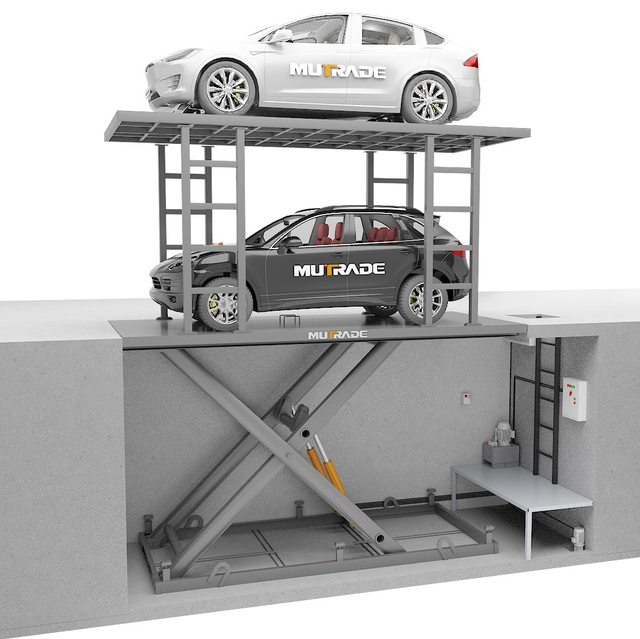
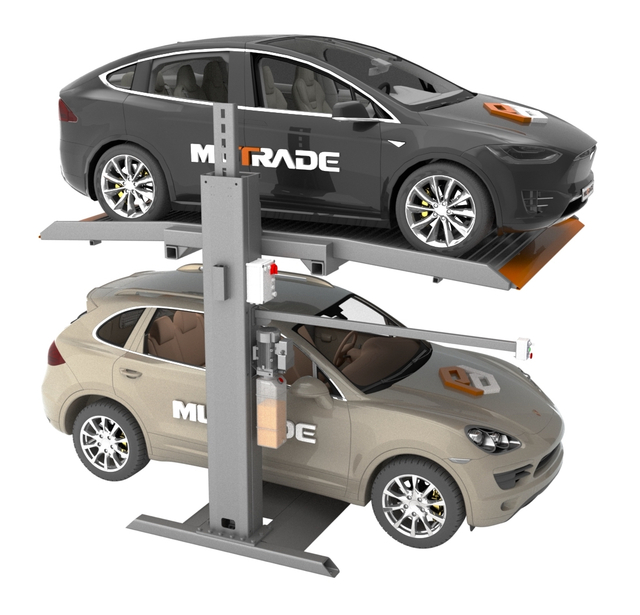
Automated and semi-automated parking systems use mechanical lifts, platforms, and automated transfer mechanisms to increase vehicle storage capacity. By utilizing vertical space and reducing conventional driving aisles in suitable configurations, these systems can improve parking efficiency in urban developments.
Explore Mutrade's mechanical parking systems for space-saving parking solutions.
Cloud-based parking management systems support remote monitoring, digital payments, reservations, and centralized administration. These platforms can simplify parking operations across multiple properties and reduce dependence on manual management. Features and integration capabilities vary by software provider.
Hybrid parking systems combine multiple technologies, such as LPR, traditional barriers, cloud management, and mechanical parking equipment. This approach allows property owners to upgrade existing facilities gradually while maintaining operational flexibility and accommodating different user requirements.

System Type | Primary Function | Best Applications |
|---|---|---|
Traditional PARCS | Entry control and parking payments | Hospitals, airports, commercial garages |
LPR / Ticketless | Automated vehicle identification | Offices, residential properties |
Automated Parking | Increase parking capacity | Dense urban developments |
Cloud-Based Management | Remote monitoring and digital operations | Multi-site parking facilities |
Hybrid Systems | Combine access, software, and parking equipment | Mixed-use and upgraded facilities |
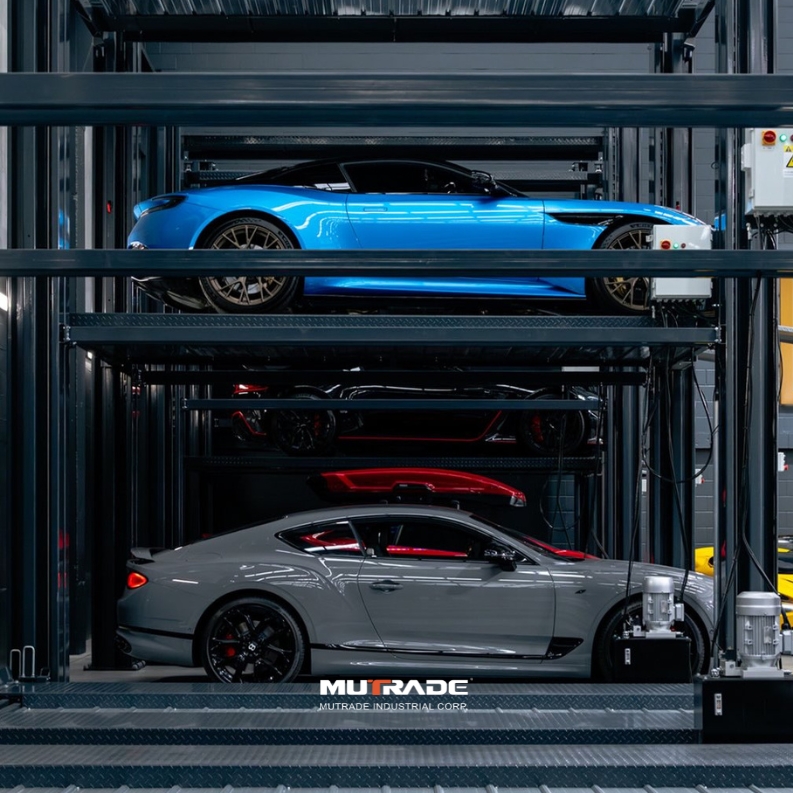
Selecting a smart parking management system requires evaluating equipment reliability, operational efficiency, software capabilities, and long-term maintenance costs. The best solution should meet actual parking demand, support future expansion, and integrate with existing facility operations.
Parking system reliability depends on equipment durability, operating frequency, environmental protection, and maintenance accessibility. Buyers should assess mechanical components, safety features, diagnostic capabilities, spare parts availability, and supplier response times to minimize downtime.
For space-efficient parking infrastructure, explore Mutrade's automated parking systems and mechanical parking solutions.
Parking management software can support occupancy monitoring, access control, transaction reporting, and operational analysis. When evaluating software-enabled parking facilities, buyers should confirm dashboard functions, reporting capabilities, data export options, and compatibility with parking equipment.
Scalable parking systems should accommodate changing vehicle volumes and future facility expansion. For properties with multiple locations, centralized management and compatible control interfaces can simplify administration. Modular mechanical parking equipment may also help increase capacity without expanding the existing parking footprint.
EV charging integration is becoming an important consideration in modern parking facilities. Project planners should evaluate electrical capacity, charging equipment placement, and compatibility with parking access or billing systems. Integration requirements depend on the selected parking equipment and third-party charging infrastructure.
Parking access control systems may incorporate license plate recognition (LPR), automated barriers, and digital enforcement tools to improve vehicle entry and exit management. These technologies can reduce manual administration and support more consistent parking operations, provided they are compatible with the overall system design.
Smart parking system security requires appropriate protection of payment information, vehicle data, and user records. Buyers should evaluate applicable PCI DSS requirements, privacy regulations, accessibility standards, and supplier security documentation. Compliance requirements vary by country, payment architecture, and system configuration.
Evaluation Factor | What Buyers Should Check | Operational Benefit |
|---|---|---|
Equipment Reliability | Duty cycle, safety systems, maintenance | Reduced downtime |
Software Capabilities | Monitoring, reports, data export | Better operational visibility |
Scalability | Capacity expansion and modular design | Future flexibility |
EV Compatibility | Electrical and charging integration | Support for EV users |
Access Control | LPR, barriers, entry management | Smoother vehicle movement |
Security & Compliance | Data protection and relevant standards | Lower operational risk |
Supplier Support | Spare parts, documentation, service | Long-term reliability |
For projects requiring additional parking capacity, explore Mutrade's parking equipment and automated parking solutions to compare available system configurations.
Conduct a comprehensive site audit of existing infrastructure, mapping conduit paths, electrical panel capacity, and network drop locations.
Define technical integration requirements with your IT team to ensure compatibility with current access control panels and property management software.
Request proof-of-concept demonstrations from three shortlisted vendors using a sandbox environment to verify API capabilities.
Draft a phased deployment schedule that prioritizes off-peak installation and includes manual override protocols to maintain traffic flow.
A: Most hardware components, such as barrier gates and ticket dispensers, have an operational lifespan of 7 to 10 years with regular preventative maintenance. Cloud-based software and LPR cameras require more frequent updates. Camera hardware typically needs upgrades every 5 to 7 years to keep pace with optical recognition technology advancements and changing network standards.
A: Yes. Most modern LPR cameras and cloud platforms send standard relay signals to existing barrier gates. As long as the legacy gate motor is functional and accepts standard dry contact input commands, you can upgrade to ticketless entry without replacing the physical barriers.
A: Traditional PARCS rely heavily on physical hardware like ticket dispensers, barrier gates, and on-site payment kiosks to control access. Smart parking systems shift the focus to software, utilizing LPR, mobile apps, digital payments, and cloud-based management to create a frictionless, hardware-light user experience.
A: Modern systems replace physical validation stamps with digital portals. Retail tenants log into a web-based dashboard or use a tablet to enter a customer's license plate or scan a mobile QR code. The system instantly applies the pre-configured discount rule to the transient parker's digital session.
A: Advanced systems use open APIs to sync with EV charging networks. This allows the parking platform to monitor which vehicles are parked in EV spaces, verify if they are actively charging, and consolidate the parking duration fee and the electricity usage fee into a single user transaction.
A: Enterprise-grade systems feature local survivability. LPR cameras and local lane controllers cache the database of authorized monthly parkers, allowing tenants to enter and exit. Payment kiosks securely store transient credit card tokens offline and process the batch transactions automatically once internet connectivity is restored.